Breaking through the Boston Marathon
Bob Hall started a wheelchair racing revolution when he crossed the finish line at the 1975 Boston Marathon.

Bob Hall passed away last month at the age of 74, but his legacy was on full display in Boston on Monday, where over 100 adaptive athletes competed across eight para divisions for over $300,000 in prize money. What started as a simple challenge has transformed into a global movement for inclusion at some of the world’s biggest races.
Three hours or bust
Bob Hall was born in Cambridge, MA in 1951. He contracted polio when he was only 10 months old, causing him to lose much of the strength and mobility in his lower legs. Hall attended Belmont High School and served as the team manager for both the basketball and football teams. It wasn’t until he was introduced to wheelchair basketball in the early 1970’s that he discovered his own athletic ambitions.
In 1974, Hall won the National Wheelchair Mile and was promptly challenged by a competitor to take on a marathon. When he heard other athletes discussing their plans to enter Boston, he set a goal to win his hometown race before anyone else could claim it.
The only problem was that no one had ever officially completed the Boston Marathon using a wheelchair. A Vietnam veteran named Eugene Roberts had tried in 1970, but his bid took over 6 hours and was not recognized by the Boston Athletic Association (BAA). Race officials from the BAA told Hall that he would only earn a medal if he could finish the race in under three hours. He took them by their word and spent the winter training with able-bodied runners from the Greater Boston Track Club, adapting their workouts on-the-fly.
Hall started the race alongside the rest of the field in a modified hospital wheelchair with four wheels — a relic that is completely unrecognizable compared to the sleek, three-wheeled versions of today. He finished the race in 2 hours and 58 minutes to become the first wheelchair champion in the history of the Boston Marathon.
Hall was quick to praise the other runners and fans for giving him space on the downhills and encouraging him through the entire course. “I don’t think I ever stopped smiling through the whole race… It was a cooperative, mutual venture,” he said.

Innovation and courage
Despite Hall’s achievement, the fight for inclusion was just getting started. It took another nine years of increasing participation, political pressure, and elite performances for the BAA to officially add a wheelchair division. In 1978, Hall had to sue the New York City Marathon for the right to compete — an issue that lingered for decades until the race finally included men's and women's wheelchair divisions in the year 2000.
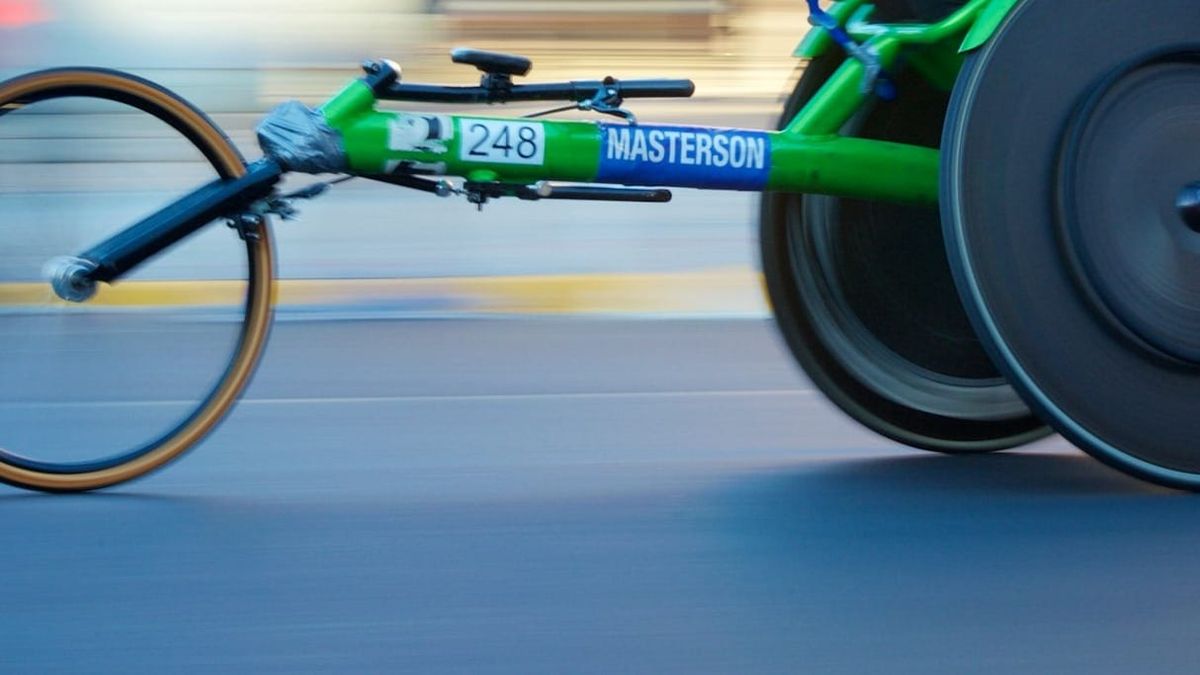
Like many para athletes, Bob Hall became an amateur engineer and mechanic by necessity. He tinkered with different designs and began building his own lightweight wheelchairs under the brand name Hall’s Wheels, becoming one of the first athletes in the world to create a purpose-built chair for racing. Many of today’s top competitors, including Tatyana McFadden and Marcel Hug, got their start using his designs. In many ways, Bob Hall created the blueprint for the aerodynamic, carbon fiber chairs of today.
Hall won his second Boston Marathon in 1977 and continued to be involved with the race for the rest of his life. In 2025, he served as the marathon’s Grand Marshal for the 50th anniversary of his ground-breaking race. The BAA celebrated the milestone, stating:
"Bob designed innovative wheelchair equipment, raced with courage, and was proud to be a two-time Boston Marathon champion. He helped lead a technological change, transforming simple wheelchairs into racing chairs built for peak athletic performance. Bob's influence and effort five decades ago led to the global circuit of wheelchair racing today."
Access for the masses
Although wheelchair racing equipment has never been better for the most elite athletes, Hall also recognized the widening accessibility gap for everyone else. Marcel Hug (who just won his ninth Boston Marathon) competes in a $50,000 chair designed by a Swiss motorsport company that also builds Formula 1 cars. Susannah Scaroni (the 2025 Boston champion) uses a $40,000 chair produced by Honda that is tailored to her exact dimensions and unique positioning, down to the millimeter.
In order to provide greater access, Hall worked with REquipment, a Massachusetts-based organization, to start the Bob Hall Legacy Fund. The fund raises money through Boston Marathon charity bibs and provides wheelchairs and other mobility aids to amateur athletes and other people with disabilities.
Over 1,900 wheelchair racers have finished the Boston Marathon since Bob Hall pushed his way from Hopkinton to Boston in 1975. Hall earned his place in history with athleticism and endurance, but his real legacy is the ingenuity that helped pave a more inclusive path for running.